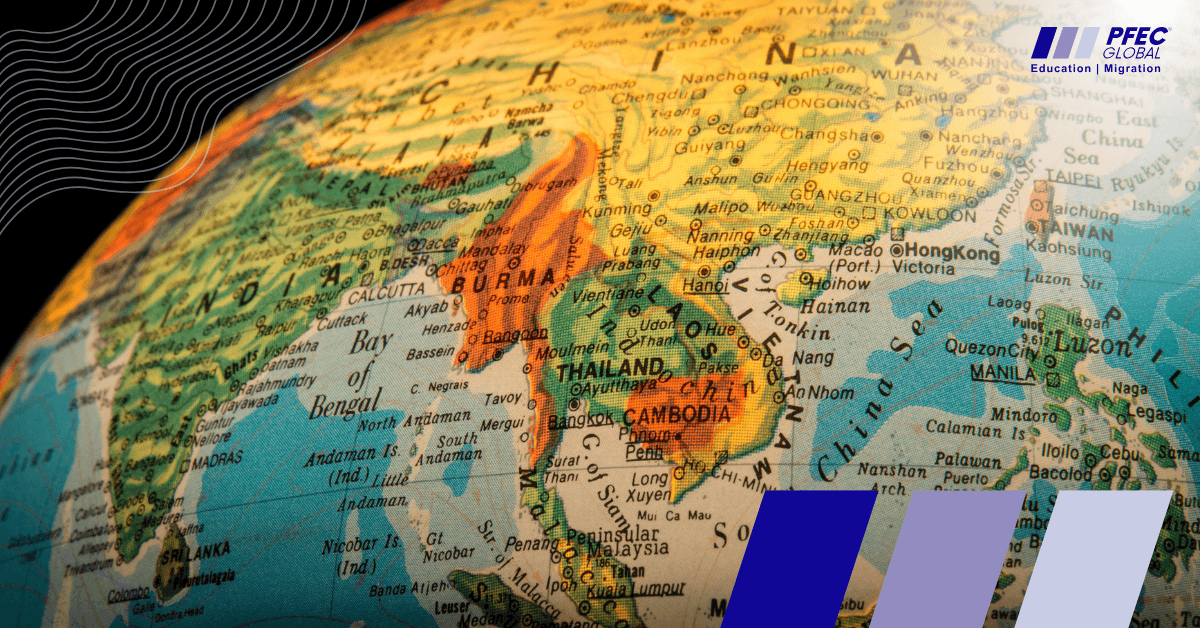
A significant regulatory shift has just been announced that directly impacts international students from South Asia planning to study in Australia. On January 8, 2026, the Australian Department of Education released a PRISMS notification detailing stricter Assessment Levels (AL) for several key South Asian nations .
At PFEC Global, we understand that changes to visa and university entry requirements can be stressful. We are committed to keeping you informed and helping you navigate these new compliance measures with confidence. Here is a detailed breakdown of the update and what it means for your application.
Understanding the New Assessment Levels
The Australian government assigns an “Assessment Level” to each country to manage immigration risk. The scale runs from AL 1 (Lowest Risk) to AL 3 (Highest Risk).
The latest update has downgraded the risk rating for multiple South Asian countries, moving them to higher Assessment Levels. This change effectively means that applicants from these nations will now face tighter scrutiny and must provide more robust documentary evidence regarding their financial capacity and English proficiency .

Key Changes by Country
Country | Previous Level | New Level | Impact on Application |
Bangladesh | AL 1 | AL 3 | High Impact: Significant increase in financial evidence required. |
Bhutan | AL 2 | AL 3 | High Impact: Stricter evidentiary requirements for visa approval. |
India | AL 2 | AL 3 | High Impact: Enhanced scrutiny on financial background and genuine intent. |
Nepal | AL 2 | AL 3 | High Impact: Tighter verification of all supporting documents. |
Sri Lanka | AL 1 | AL 2 | Moderate Impact: Increased documentation needed compared to previous streamlined processing. |
Moderate Impact: Increased documentation needed compared to previous streamlined processing.
Why Is This Happening?
The Department of Education has cited “emerging integrity issues” as the primary driver for this crackdown . The goal is to protect the integrity of Australia’s international education sector by filtering out non-genuine entrants.
Key concerns highlighted by authorities include:
- Sophisticated Fraud: The detection of “search funds,” where unrelated individuals transfer money into a student’s account solely to pass financial verification checks, has alarmed regulators .
- Document Integrity: Reports of complicity involving “package agents” and certain bank officials facilitating fraudulent applications have necessitated these stricter checks .
Minister for Education Julian Hill defended the move, noting that while Australia remains a top destination globally, the government must act on clear evidence of fraud to maintain the system’s reputation .
What This Means for PFEC Global Students
While this news may seem daunting, it is important to remember that genuine students with authentic documentation can still succeed. The Australian government welcomes students who are here to study and contribute positively.
How We Help: As an ethical agency with a strong presence in Australia, Bangladesh, India, and Sri Lanka, PFEC Global is uniquely positioned to help you navigate these changes.
- Compliance Expertise: Our team of registered migration agents and education counselors is fully briefed on the new AL 3 evidentiary requirements.
- Document Verification: We assist you in preparing a “decision-ready” application that meets the heightened standards for financial proof and English language scores.
- Genuine Guidance: We have zero tolerance for fraud. Our high success rate is built on presenting honest, verifiable student profiles to the Department of Home Affairs.
Next Steps
If you are an applicant from Bangladesh, India, Nepal, Bhutan, or Sri Lanka, do not panic. These changes simply mean your application must be thorough and transparent.
We recommend contacting your nearest PFEC Global office immediately to review your current documentation. Whether you are in Dhaka, Chattogram, Kolkata, Colombo, or onshore in Melbourne/Sydney, our experts are ready to ensure your study abroad dreams remain on track despite these regulatory updates.
Contact PFEC Global today to secure your future.
Frequently Asked Questions (FAQ)
What are Australia student visa Assessment Levels (AL)?
Assessment Levels classify countries based on immigration risk, ranging from AL1 (low risk) to AL3 (high risk), affecting visa documentation requirements.
Which countries are affected by the 2026 Assessment Level changes?
Bangladesh, India, Nepal, and Bhutan are now AL3, while Sri Lanka has moved to AL2, meaning stricter requirements for applicants.
How do higher Assessment Levels impact visa applications?
Students must provide stronger financial proof, clearer documentation, and meet stricter English and genuine student requirements.
Can students still get an Australian student visa after these changes?
Yes. Genuine students with complete and accurate documents can still successfully obtain visas despite stricter checks.
Why did Australia increase Assessment Levels for South Asian countries?
The changes aim to reduce fraud, improve document integrity, and ensure only genuine students enter the education system.